Saturday, July 08, 2006

BB goes off the boil

As T S Eliot says, human kind cannot bear very much reality (Burnt Norton) , and he was of course thinking of BB 7 and Love Island (not Celebrity Love Island, as we shall see).

Big Brother, despite the media hysteria it has engendered, has singularly failed so far to drum up any great enthusiasm in its audience. Watercooler television it is not. You can imagine the producers find this hard to believe: have they not provided madness, surgery-enhanced breasts, screaming fits, and various near-couplings? Well, yes, and more than enough. But BB has also overpacked the house with too many too similar people, and by the tedious and unoriginal second house concept has meant that we still have almost as many inmates as we started with. The main interest as the series develops is usually the interplay between tensions within the house leading to nominations, and then the judgement of the public on those chosen. BB has ridden roughshod over both elements, and there is much less interest in watching the arbitrary acts of an absolute tyrant. Nevertheless, BB has proved a ratings juggernaut, presumably because its target audience, the young, are too lazy, drunk, drugged or stupid to consider doing anything other than watching.

It remains to be seen whether Love Island urges them to turn over. I hope not, but that’s probably because I find the prurience of promoting on-screen sex as the sole purpose for a show distasteful. It is by now established that any discussion of Celebrity programmes must include a joke about Z listers, but I shall break that rule and instead provide a catalogue raisonee of my classification of celebrities:

A superstars whose fame and influence is so great that they can use it to succeed in fields far divorced from their initial area of success (ie Arnie moves from bodybuilding through barely coherent acting to running the world’s fifth biggest economy)
B stars who rule their chosen realm but fail when they move outside it (Neil Young filmmaker, Bob Dylan actor)
C stars who have had a varied career but are mainly associated with one key role (most of the cast of The Bill who started off in soaps)
D stars whose fame is based solely on their one major role (one-hit-wonders)
E other actors (etc) who wouldn’t be famous at all if were not for their extracurricular activities (I’m sure no-one would remember Daniella Westbrook at all if she hadn’t dissolved her nose in cocaine)
F other actors who never made it to fame
G people associated peripherally with F-listers (glamour models, promotion models)
H lovers and children of stars, who achieve fame due to media notoriety
I lovers and children of near stars who achieve fame due to media notoriety
J lovers and children who never achieve fame
K relatives of J listers


This makes some sort of sense to me. So, let’s look at the Love Island line-up. By my count, the highest anyone can get is D (ex-reality), with most in G-H. In some ways this hardly matters, if the series is seen as reality. There is however something much more interesting about Celebrity reality, because it gives an unusual view of people who have an established public persona already. People may well have suspected previously that George Galloway was a pompous bully, or Michael Barrymore was a needy paranoid, or Faria Alam was a manipulative self-publicist, but now they could test this perception, and find out, well, that they were right.

ITV are desperate to turn Love Island into the hit of the summer, having seen their audience, and advertising revenue falling for years. In the absence of positive press (you might say that since the filming is so remote, there was no prospect of bargaining by granting better access), they have persuaded a producer to blog for the Guardian.
The live reality plays directly into my office and I watch as the celebrity stand-ins getting ready for bed. Two snuggle up and I try to imagine how much more interesting it will be when the real celebs are in there in less than a week's time.

Not more interesting at all. And what do you mean, ‘real celebs’? My basic definition of a celebrity is someone you recognize without being told who they area. These you don’t recognise even after you’ve been told.

Monday, June 19, 2006

Sandi Thom: I wish I was a PR man with money in the bank

Her CD has a sticker: "The singer who webcast to the world from her Tooting basement". It is becoming clear that, far from being an impoverished artist using new technology to reach an audience, her success is a triumph of conventional marketing. The webcasts were effectively showcase gigs intended to garner major label interest, after last year's small-label release failed to get any higher than No. 55 despite Radio 2 airplay. The vagueness of ST and her backers about the numbers of viewers of the webcast smacks of fiction: if there really were 70,000 (or, later, 40,000) people tuning in having picked up on an Internet buzz, it is astonishing that so few blogged about it, mentioned in on a website measured by Technorati, or visited her MySpace site: the Internet buzz followed the press reports, not the other way round. It looks as if she used the webcast angle as a way of making unverifiable claims for popularity in order to get the labels hungry. They did, and RCA (or rather Sony BMG, trading as RCA) eventually snapped her up.

Her current success has been driven partly by expensive PR: when was the last time a debut (or 'debut') single was released (re-released) with two weeks of TV adverts? But more than that, there has been the collusion of the press, which has picked up on the webcast thing and given her massive exposure in the print media. A little digging, or even the application of memory or common sense, would have led to a more critical approach, but everyone seems to have concluded, with the editor in The Man Who Shot Liberty valance, that given the choice of telling the truth or printing the legend, you should print the legend.

The 'new star created by the Internet' story is a popular one, one that people keep trying to foist on any act with enough savvy to register their own web domain. I think the appeal lies in the Cinderella myth: the daydream that someone can become rich and famous overnight, without having paid any dues. ST has been plugging away for years, touring, recording, session singing, but that's not what people want: they want Chantelle success, similar to the daydream you enjoy in the period between buying a lottery ticket and finding out you haven't won. This is nothing new: when video first came along, Toni Basil found instant stardom (although Wikipedia tells me that her first single was recorded 15 years before 'Hey Mickey'); when Paul Macartney 'discovered' Mary Hopkin, she was already an experienced and well-trained singer in the Welsh music scene.

What is perhaps surprising is the fury that ST's success has unleashed. The air is thick with complaints about a 'cynical marketing ploy', a phrase that has always seemed to me to be redundant: what, you mean it isn't a good old philanthropic altruistic marketing ploy? Yet those who continue to be amazed at the antics of the music business always seem to forget the 'business' part. Music involves money. I can remember one rock god saying despairingly that you could tell you had made it when you were employing people you didn't even know about. Music is expensive. Mainstream acts can revel in this: the manufactured nature of the Spice Girls, Westlife, the Sugababes is part of the fun. But for left-field acts you're supposed to ignore it, so that U2, the Rolling Stones, Sting, retain some credibility (or are supposed to) while also raking in money faster than many small countries. Again, this is nothing new: Pink Floyd appeared in the 60s on the Harvest label, an EMI owned company which was intended to obscure the corporate nature of the organisation behind the band.

It would of course be totally cynical to suggest that the press gave the Sandi story such an easy ride because Sony BMG places so much advertising in their papers. It wasn't like that in '69 or '77. Except it was- as Patrik Fitzgerald said at the time, it was "Come and get your punk in Woolworth's / Bondage trousers - twelve pounds" (Make it safe).

I was going to put a link to Sandi Thom's website, but then I thought, 'Why should I? She never links to mine!' (Copyright the estate of Spike Milligan) Her website needs Flash to view it. These crazy web nuts!


Update

Sandi appeared on BBC Radio 4's arts magazine, Front Row, on Wednesday 19/7/06, and was asked specifically about the webcast/PR controversy. She said the whole 'penniless songwriter' thing had come from the press, not from her, since she acknowldedges she had the backing of a small record label, a management company and a PR firm before the Tooting webcasts started. This is a little disingenuous, since her she has certainly seemed keen to emphasise the squalor of the 'piss-stained basement', as if to imply that she had no backing. Quized about the webcast audience figures, she preferred to talk about how cool it was that people [however many there were] were viewing from all over the world. That doesn't impress me much: even this humble blog is regularly visited by sleepless people in Southeast Asia who want to know what "Blowin' in the Wind" means , or about megalomaniacs. Sher did end by endorsing the Web as a place where people can say what they think, which is good in its way, I suppose.

Saturday, June 03, 2006

Bob Dylan and the Dead Sea Scrolls

"You gotta heed the Teacher of Righteousness
If you want to know the Way
The Wicked Priest's a spouter of lies
You can't belie-ee-eeve him when he prays"

Could be a John Wesley Harding , Slow Train Coming or Infidels outtake, but in fact has been cobbled together by me: the phrases in bold are from the Dead Sea Scrolls. In Chronicles Vol. 1, and elsewhere, he has made it clear that he doesn't (as most of his commentators imply) sit down with his reference books around him and laboriously construct his songs like a crossword. Instead, he simply inhales a wide range of cultural sources and leaves them to emerge from his unconscious. But for all four of the key elements of the Scrolls texts to reflect so closely his concerns is evidence enough for me that he has at some point come across them.

BB7- the revenge of the housemates

I await with interest the Endemol producers' verdict on this series' selection process: were these really the most psychologically suited 12 people in Britain? Bizarrely, as series runs into series, while the viewing trend is generally down, the number of would-be participants continues to rise, even though it should by now be clear that even winning cannot provide lasting fame or even notoriety.

Previous series have provided most interest in demonstrating the Stockholm syndrome, as the housemates became institutionalised and came to identify with BB who exerted arbitrary power over them. This time around, it's more the Stanford Prison Experiment, as the group divided immediately into two factions and the dominant group then savagely attacked any non-conforming individuals. This might be seen as depressing, especially since many of the silent majority might be expected in other circumstances to protest against such victimisation. The risk, of course, is that to do so is to become a target oneself. But all this really shows is that tolerance is not a 'natural' product of human society: it has to be fought for.

But one has to wonder at those who volunteer to effectively be imprisoned for 3 months, with a group of unknown and possibly hostile co-prisoners, at the mercy of a capricious authority with the power to control sleep, food, and clothing. In the past, resistance by the inmates has been limited to arguing with Big Brother and refusing to cooperate in tasks. By definition, these fail. This time, the three walkers have shown the way. Rather than face the full-length ordeal, or the humiliation of public eviction, they have simply walked out once they recognised that they could achieve no more. Unless BB starts to substantially reward all those who stay the course, or really lock them up, then the merry-go-round of bringing in new housemates to replace the walked will become a standard feature of the series.

There has been some discussion about how to make the concept more interesting (now it is clear that 20s wannabe celebrities have no ability at all to say anything worth hearing), and one aspect that hasn't been explored is the exploitation of the isolation from the external world. For example, it would be very funny (for us) if, as a special concession, details of England's triumphant World Cup campaign were to be provided, so that when the victors emerge from the house, they are mystified at the despondency of the crowd who watched the early departure from the contest at the hands of plucky Trinidad. Or if BB were to announce that a Bird Flu outbreak in the vicinity meant that they would have to take all sorts of precautions, check for symptoms etc. Now that would be worth watching.

Global warming and the madness of crowds

Tolstoy:
"At the approach of danger there are always two voices that speak with equal power in the human soul: one very reasonably tells a man to consider the nature of danger and the means of escaping it; the other, still more reasonably, says that it is too depressing and painful to think of the danger since it is not in man's power to foresee everything and avert the general course of events, and it is therefore better to disregard what is painful till it comes, and to think about what is pleasant. In solitude, a man generally listens to the first voice, but in society to the second." (War and Peace, Book X Chapter XVII).

Friday, June 02, 2006

Thoughts written on hotel notepaper

A distinctive smell, a mixture of gas, damp and tobacco, lingers in the carpets. The corridors snake around corners, ducking underlow arches, stepping up and down on a whim as they negotiate the building's extensions and additions. Passages run on out of view: this place could house an army. It's silent now, though: this is off season, and I'm almost alone.

Wind and rain deter all but the hardiest of tourists, and the high street wears its winter plumage of shuttered shops, closed restaurants, and ragged bunting left over from last year. The townsfolk have a haunted look- they know this place in both its modes, and would find it hard to decide which is better: winter solitude or summer overcrowding. But within them lies doubt- perhaps this time the visitors will not return, perhaps last summer was the final season.

As a result, I feel the weight of responsibility upon me- if I don't get a paper from the shop, use the telephone, buy a drink, the local economy may collapse into the chasm upon whose edge it teeters. When the best the marketing campaign can sugegst is a weterhered gravestone and an ill-defined association with Arthurian legend, eventual defeat appears inevitable.

Wednesday, May 24, 2006

The Da Vinci Code reviewed

"With a fragmented plot that is less plausible than a Harry Potter movie, it combines the historical seriousness of Monty Python's Life of Brian with the deep emotional characterisation of the Wacky Races"

Martin Kemp, The Guardian, 22/5/06

Yes, but he doesn't say whether he likes it or not.

Actually I think part of my antipathy to Dan Brown and all his works derives from the strong impression that Henry Lincoln's 1974 TV documentary The Priest, the Painter, and the Devil left upon me as a teenager: its tortuous search through hidden symbols and codes seemed astounding. Where I think the bats entered the belfry was in the later incarnations of the story in which we were expected not only to admire such stuff but to actually believe it was true.

Wales: a brief economic history

A boy stands next to his grandfather, leaning on a gate watching the grass waving in the wind. The grandfather sighs. "In my time, bach, all this was factories".

Saturday, May 13, 2006

Life isn't fair- and whose fault is that?

Update, 2009: the Cancer Baby blog has now been taken down, and people searching for it often end up here. What follows is wrote I wrote at the time of her death, and was a reaction to what I felt was mistaken rhetoric adopted by her virtual well-wishers which implied that they hadn't understood her stance.

___________________________
I have written before about Cancer, baby who faced the dark prospects of infertility, cancer and death with wit and honesty. For several months now she had been ominously silent, and has now died. And the world is poorer for it: we need sensible people who can write.

I have no great belief in the power of wishful thinking or blind optimism, but a lot of people do. If you read the Comments to her more harrowing posts you will see that there were many readers out there praying to God for her to recover (she knew her odds were bad). I guess they just didn't pray hard enough, or weren't good enough, or she had been too evil in some way (and more evil than all the other evil people who somehow wander around prospering and flagrantly unsmitten making everyone else's life worse), or (and this is the most revolting option), she died because He wanted her to, reducing her to some minion that can be sacrificed in pursuit of some greater aim. I do not believe that any ends can justify such means. "If you're suffering, it's because God wants you to" isn't really very comforting.

When people explain why prayers are not answered, they usually say something like "If people were given everything they asked for they would never learn responsibility for themselves". Oddly, they assume that people would automatically ask for things that benefit them directly. I saw on one blog someone tell the story of a discussion in the run-up to Christmas when a four-year-old was asked what they wanted as a present: the reply "that all the children in the world have clothes and enough to eat" put something of a damper on the consumer binge in the ensuing theological contortions. I know you could argue that such requests are in the end selfish because they would make the praying person feel better, but that is surely stetching it: you might as well say that God shouldn't make sunsets beautiful because people enjoy them.

None of this is news, of course. But it is so easy to respond to tragedy with formulations that seek some greater meaning or deny the reality of loss ("they're still out there somewhere", "they're smiling in Heaven": they are DEAD, they are GONE).

No. Shit happens, and happens all the time. It just does, not "Because..." or even "In spite of...". All you can do is hope that it doesn't happen to you for as long as possible, and accept, with whatever grace you can muster, that it eventually will.

And if Cancer Baby's sad and cruel end has helped hundreds of people realise this then she she did not suffer in vain. So that's all right then. No, it's not. The undertaking business really picked up after all the stockbrokers committed suicide in the Wall Street Crash, but even the undertakers would rather it hadn't.

It is hard for those who are suffering, and even harder for those who care for them, to cope with the idea that the suffering serves no purpose, that is is just stuff, that a night of pain was just a night of pain; it didn't purify or clarify or sanctify, it was just a bad experience that one would be better off not having had. But just because it's hard, that doesn't mean it's wrong. This isn't just what I believe- she did too. I'll miss her.

Update

As you can see below, my comment on Cancer Baby's blog has been criticised as insensitive. It wasn't my intention to cause any additional anguish to her family and friends, but rather to remind the large number of blog readers without any direct involvement of Cancer Baby's doctrine that one should face reality as it is rather than more comfortable illusion, in which she explicitly (and courageously) renounced heroism and victimhood. Perhaps the only thing that we can salvage from the trials of life is the determination to learn from them; it is a good thing to re-examine our core beliefs from time to time and to think hard about what they imply.

Having said that, I also recognise that there is a time and place for such debates, and there should be a choice about how one reacts, and that this was an error. I tried shortly after posting it, and again just now, to delete or edit my comment, but it appears to be indelible. Post in haste, repent at leisure.

Saturday, May 06, 2006

News item

The lecture series on natural methods of birth control has been cancelled: one of the speakers was only available for part of the month, and the other had to pull out at the last minute.

Saturday, April 29, 2006

Languor in Leeds: Corinne Bailey Rae's Yorkshire

Corinne Bailey Rae's 'Put your records on' is all over the radio at the moment, and is a charming piece of pop. But it doesn't quite ring true of Corinne's Yorkshire home, so when it comes on the radio, I have to add a response to the less credible lines:


Summer came like cinnamon, So sweet IN LEEDS
Little girls double-dutch on the concrete. IN LEEDS

Blue as the sky, sombre and lonely, IN LEEDS
Sipping tea in the bar by the road side, IN LEEDS


But I suppose the most surprising thing is that she knows what records are, rather than guessing vaguely that they were some quaint technology that old people used to have before there was electricity.

Friday, April 28, 2006

Bloggers Anonymous

There is a popular fallacy in the blogosphere that 'we' share some great set of beliefs or attitudes. No, 'we' share a technology, and have nothing more in common than those who produce works on paper, or in any other medium. Indeed, the absence of critical oversight means that opinions of all sorts can be voiced. My experience of blog surfing is that you are only two clicks away from a loony. Bloggers blog for a range of reasons and make different choices about how they deal with the tension between the freedom to say anything online and the possibility that they will at some point have to answer for these statements to real people. It is a well-known phenomenon that people who started out anonymously, and wild in their indiscretions, often find themselves hemmed in by finding that some of their subjects are starting to read it.

In general I'd say this is hardly an issue that concerns me, partly because my writing aspirations are not confined to cyberspace, and therefore true anonymity was hardly an option (anyone interested enough could unmask me on Google in about two seconds, and I have been actively advertising my blog to my family on the principle of hiding in plain sight). Instead, I have merely used a mild screen to create a little distance between my professional/real identity and what I write here, in order to allow me to be more frivolous and controversial than if I were continually on record. Paradoxically, my writing (of all sorts) tends to be light on personal information: my poetry, for example, ranges far and wide in subject matter, but rarely gets close to my family or my work. But then, this blog is much closer in spirit to print than many I read: I would not, under any concievable circumstances, write an entry about what I had for breakfast (yawn), or how bad the rush hour traffic is (shock!), or whether I should commit because it's been like three weeks and I think he's ready but I'm not sure (zzz). Those that do obviously have a different idea of what they are blogging for. In a few cases, anonymity and the freedom to create a distinctive informal voice from nowhere creates a gossipy diary which may well be largely fictional (like the Sarcastrix and the Hot Librarian), but the vast majority stick to dreary candour, recording things that you wouldn't bother telling someone over the breakfast table, let alone setting down for posterity.

Which explains another common feature of blogs: they die. They die because their authors stop caring, because after the initial buzz of creating Web content wears off, they realise that the sort of fame where everyone is famous isn't in fact the fame they seek.

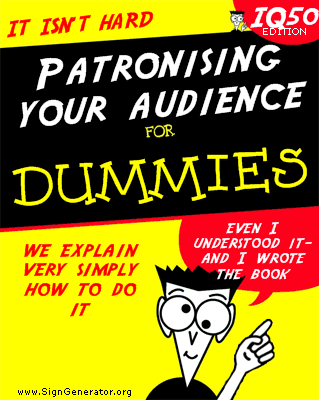
Of course I'm not patronising you

Sunday, April 23, 2006

More silly captions


Death of the chat show

Davina McAll's new chat show has generated small audiences. This is of course a terrible shock, since the last time the BBC decided to try to exploit their underused expensive talent by building a chat show around Graham Norton had similar results. Partly I think this is because those devising such programmes overestimate the audience's affection for the Big Name as a *person*. I like Davina in her Big Brother and Streetmate roles, less so in her sitcom; this isn't because I can only think of her talents in that form, it's just that that's hwere her talents lie (or so it seems to me). One of the best ways of cheering oneself up is to go through IMBD and look at all the actors who decided to leave long-running series to avoid getting typecast and who never worked again. Soap audiences, in particular, are very tolerant: if someone hangs around for long enough they will be thought of affectionately even if they can't act.

But more basically, there is a fault in understanding a chat show audience. It is, as Norton has noted, all about the guests. Good chat show hosts make their guests seem interesting, spontaneous and coherent. Unfortnately, the other half of the equation is that they should also be well-known. This makes choosing them hard. There's nothing in particular wrong with people appearing to plug their book or series, as long as they realise that when doing so they also need to provide some form of entertainment.

But chat shows have fallen in status forever. There was a time when apparently unmediated access to celebrities in their off-screen personas was in itself of interest. It came as a revelation to hear Eric Clapton in the 1970s talk about himself. This access is no longer exciting: every film comes with a dutifully dull 'Making of' film; celebrity magazines trace the ups and downs of stars' daily lives; websites can instantly provide more information than you could possibly want about the obscurist and most ephemeral of public figures. So the question about chat shows becomes: why should anyone bother? Even if Davina arranged a meeting between Leonard Cohen, Neil Young and Bob Dylan to talk about their art, I still wouldn't be tuning in.